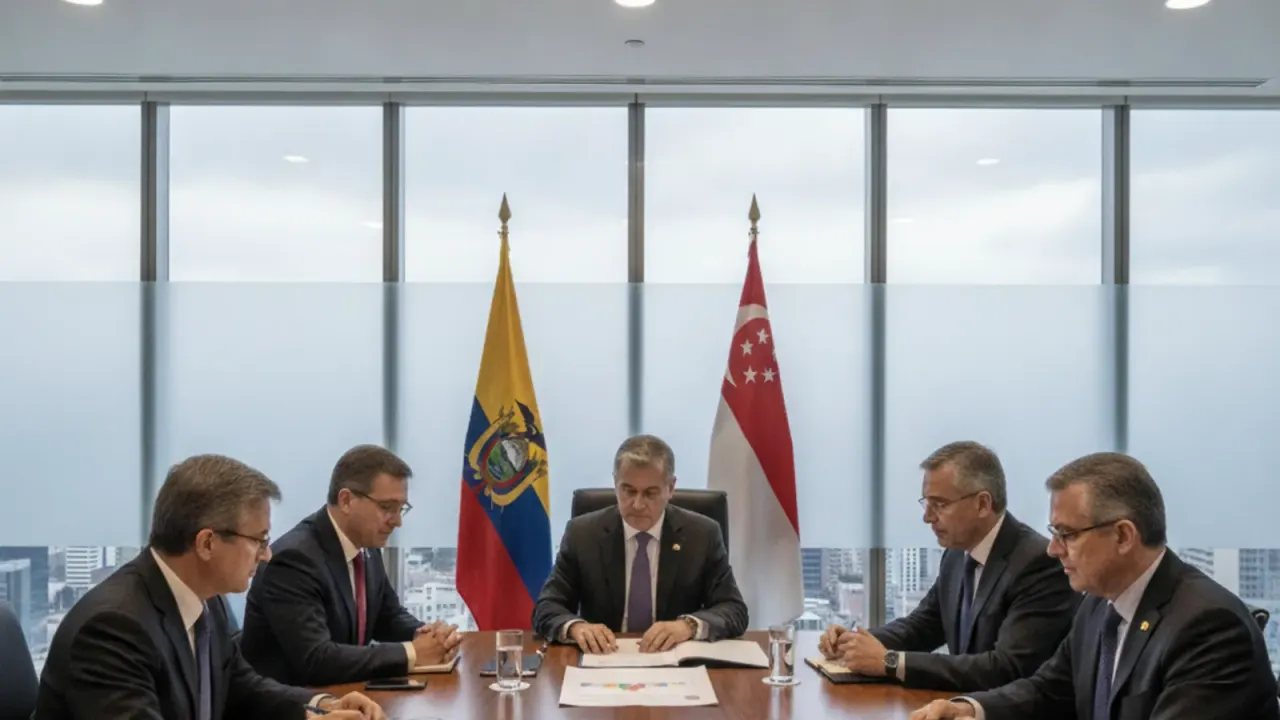
Noboa Moves the Government to Guayaquil “For Several Weeks” — Police High Command Follows

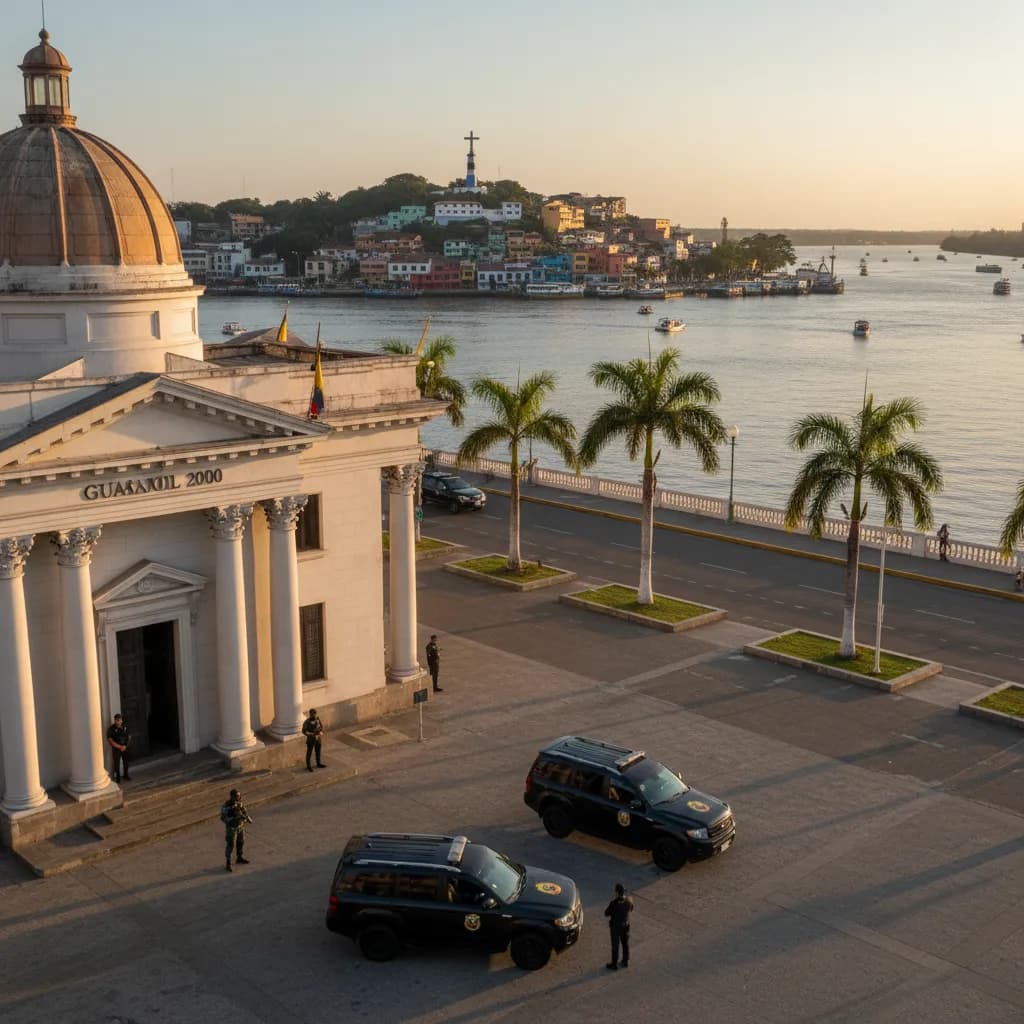
Ecuador’s government is no longer operating from the capital.
What Happened
On Friday, February 13, President Daniel Noboa announced that the national government would relocate its operational base from Quito to Guayaquil for “several weeks.” Speaking at ESPOL university’s Prosperina campus, Noboa declared:
“We will be based here as Government for several weeks, working day by day, delivering solutions, resolving problems in the territory — not fleeing.”
He added: “Guayaquil has already suffered enough, with politicians who have done whatever they pleased. The main port must become a light of hope, not a shadow.”
The National Police high command followed. Commander General Pablo Dávila and six senior generals relocated operations to Guayaquil’s Modelo Barracks under Executive Decree No. 28, focusing on nine priority districts within Zona 8 (Guayaquil, Durán, and Samborondón).
Key cabinet members — including the Ministers of Labor and Education — are now operating from Guayaquil.
The Timing Is Not Subtle
The government’s move came exactly two days after police arrested Guayaquil Mayor Aquiles Álvarez in a pre-dawn raid on February 10. Álvarez — one of Noboa’s most vocal political opponents, who had criticized the president’s military-led security strategy and hadn’t ruled out a presidential run — was detained in his pajamas by heavily armed officers. Images showed bags of cash, computers, and phones seized from his home.
Álvarez was charged in the “Caso Goleada” investigation for organized crime, money laundering, and tax fraud, then transferred to preventive detention in Latacunga — notably far from his Guayaquil power base. Vice-Mayor Tatiana Coronel assumed mayoral duties.
The opposition’s Revolución Ciudadana party (aligned with former president Rafael Correa) declared “Ecuador under dictatorship” and led protest marches in Guayaquil. Correa himself called Noboa a “mediocre aspiring Caligula” on social media.
The Official Justification
The government frames the relocation around three priorities:
- Security crisis: Guayaquil is the epicenter of Ecuador’s criminal conflict. The city’s port has become a major cocaine transit point between Colombian/Peruvian producers and U.S./European markets. Ecuador recorded 9,216 homicides in 2025 — its most violent year in history
- Municipal vacuum: With the mayor jailed, the government argues Guayaquil faces an institutional crisis requiring direct intervention
- Social programs: Noboa announced 2,000 artisan training scholarships, 1,341 academic scholarships for women aged 18-29, housing transfers, a purchase of 20,000 tons of rice from local producers, and university residence construction
Is This Legal?
Legal experts say yes — technically — but with important caveats.
Constitutional lawyer Hanne Blusztein noted that “making base” in a city “does not constitute a legal category.” No executive decree has been issued formally transferring the seat of government. The formal domicile of all state institutions remains Quito, which Article 4 of the Constitution designates as the capital.
However, Noboa has legal cover. Ecuador has been under a declared “internal armed conflict” since January 2024, and Article 165 of the Constitution grants the president authority to “transfer the seat of government to any location within national territory” during a state of exception when deemed more secure.
This isn’t new for Noboa. He temporarily moved the government to Latacunga in September 2025 after eliminating the diesel subsidy (returning to Quito by October), and has previously operated from Ibarra. President Lenín Moreno made a similar move to Guayaquil during the October 2019 fuel subsidy protests.
The Opposition’s Read
The political opposition sees a different story entirely:
- Revolución Ciudadana calls the mayor’s arrest “part of a systematic strategy to silence critical voices and intimidate democratically elected leaders”
- Criminal lawyer Pablo Encalada argues the pattern shows political persecution
- Assemblywoman Viviana Veloz warned: “For defending our Homeland and pointing out abuses of power, we could lose our freedom”
- Analysts note the optics of a president setting up operations in a rival’s city days after having that rival jailed
The government rejects these characterizations, framing Álvarez’s arrest as a routine judicial matter and the relocation as operationally necessary.
What This Means for Expats
Confused about which visa fits your situation? Book a 30-minute consultation with Chip and leave with a clear plan.
Book a consultation- Government services aren’t moving: Despite the executive relocation, ministry offices, immigration processing, visa services, and civil registry operations continue from their standard locations. This is a political-operational move, not a bureaucratic one
- Embassies stay in Quito: All 41+ foreign embassies and the U.S. Embassy remain in Quito. The U.S. Consulate General in Guayaquil continues operating normally. No diplomatic protocol changes
- Guayaquil security posture intensifies: With the police high command now operating from Guayaquil and focused on nine priority districts, expect increased military and police presence throughout the city. This may mean more checkpoints and patrols — generally positive for safety but something to be aware of
- Political tension is elevated: The mayor’s arrest, the government relocation, and opposition protests create a charged political atmosphere in Guayaquil. The demonstrations are expected to continue through the Carnival holiday weekend ending February 17. Avoid protest areas in downtown Guayaquil
- The bigger picture: Noboa is consolidating authority in Ecuador’s largest city at a time of record violence and deep political division. Whether you view this as necessary crisis management or overreach depends on your perspective — but either way, it represents a significant escalation in executive power that’s worth following
- Cuenca and the Sierra are unaffected: If you’re in Cuenca, Quito, or the highlands, this has no direct operational impact on your daily life. It does, however, signal how seriously the government views the coastal security crisis
Sources: Bloomberg, Vistazo, El Universo, Infobae, Expreso
More in Politics
View all →Keep practical Ecuador coverage free to read.
Reader support helps fund source monitoring, translation, editing, publishing, and national coverage for expats across Ecuador.
Need help with your Ecuador visa? EcuaPass handles the paperwork for you. Learn more →
Comments
No comments yet. Be the first to share your thoughts!