Daily coverage from across the country, written for the expat community
In a CNN en Espanol interview on March 20, President Noboa defended Ecuador's commercial relationship with China while reaffirming the country's deepening military and diplomatic alliance with the United States.
Three diplomatic developments in a single week: Ecuador ratified a cooperation treaty with Europol on March 26, expelled the Cuban ambassador without explanation in early March, and hosted U.S. Homeland Security Secretary Kristi Noem on March 25-26.
Ecuador has expelled all Cuban diplomatic personnel after embassy staff were reportedly filmed burning documents in the courtyard of the Cuban Embassy in Quito. The move signals a sharp break in relations between the two countries.
Ecuador's 2026 local elections will determine mayors, prefects, and city council members across the country. Contested races in Quito, Guayaquil, and Cuenca could reshape municipal governance in the cities where most expats live.
Ecuador has signed a Safe Third Country agreement with the United States, accepting deportation flights carrying over 4,700 non-Ecuadorian nationals from at least 16 different countries. The agreement makes Ecuador a receiving country for asylum seekers and migrants removed from the U.S.
A new Human Rights Watch report accuses the Ecuadorian government of continuing oil extraction in Yasuní National Park despite a 2023 referendum and Constitutional Court order to stop. The case raises serious questions about the rule of law in Ecuador.
President Noboa's executive decree MDT.2026-059 allows employers to schedule 10-hour workdays within the existing 40-hour weekly cap. Unions were not consulted, and mass protests erupted on March 13 in Quito and Guayaquil. Noboa's approval rating has dropped to 38%.
A new Human Rights Watch report reveals that Ecuador continues extracting 1.24 million barrels per month from Block 43 in Yasuní National Park — two and a half years after voters said stop, and one year after a court ordered it. The Tagaeri and Taromenane indigenous peoples remain unprotected.
Colombian President Gustavo Petro accused Ecuador of dropping bombs inside Colombia, claiming 27 charred bodies were found near the border. Ecuador's Noboa flatly denied it. The neighbors are now in their worst diplomatic crisis in years — and it's affecting everything from electricity to trade.
Despite a 2023 referendum and an Inter-American Court of Human Rights order to stop drilling, Ecuador continues pumping 44,000 barrels per day from Block 43 in Yasuní National Park. HRW documented 29 oil spills and contaminated water affecting uncontacted indigenous groups.
Cuenca has become the third Ecuadorian city to adopt a formal climate action plan, covering electric bus deployment and water source protection. Bloomberg Philanthropies has awarded the city $150,000 for youth-led environmental projects as Cuenca enters 2026 under a dramatically different hydrological reality.
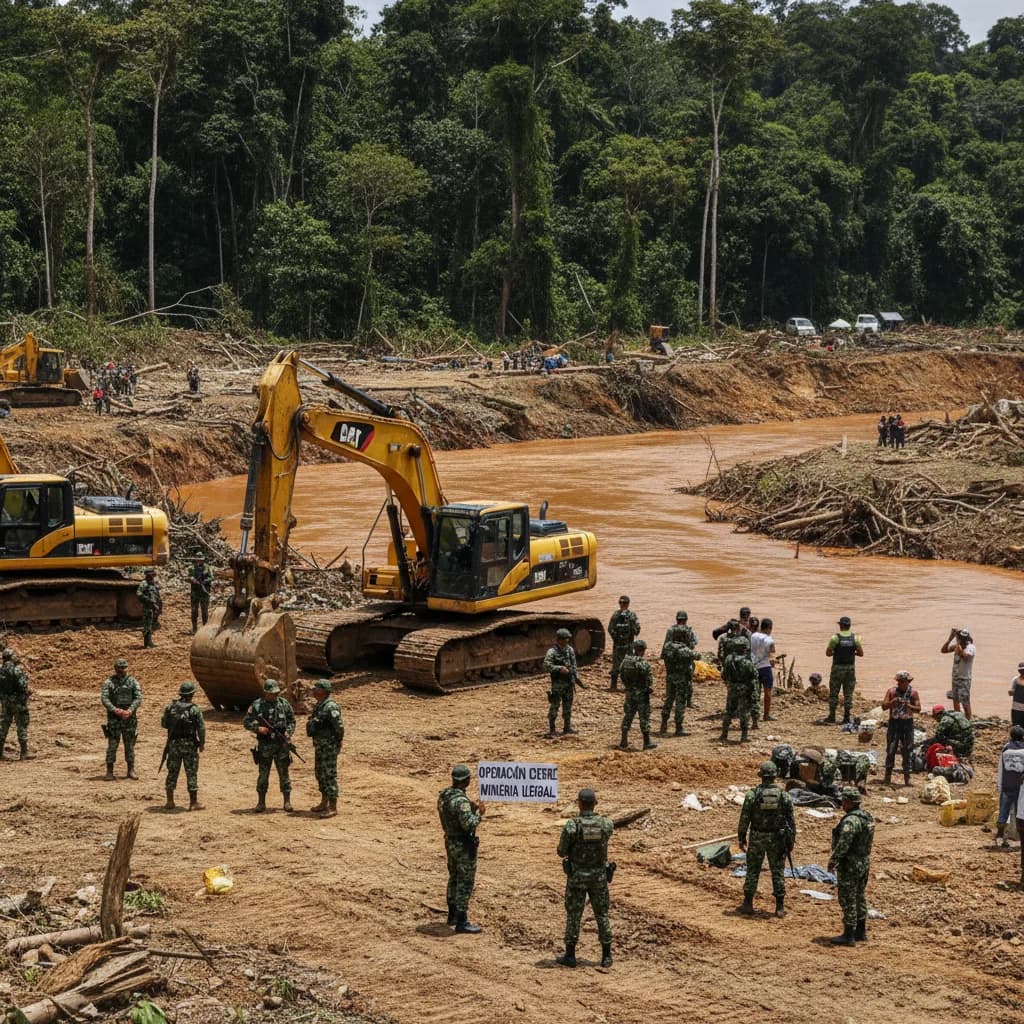
Environment Minister Ines Manzano ordered an indefinite suspension of all mining in Napo province and restrictions on 80 gold processing plants in El Oro and Loja after government tests found cyanide, arsenic, and lead in rivers exceeding safe limits.