Ecuador’s Local Auto Industry Posts a Strong July as Argentina Deal Changes the Tariff Picture

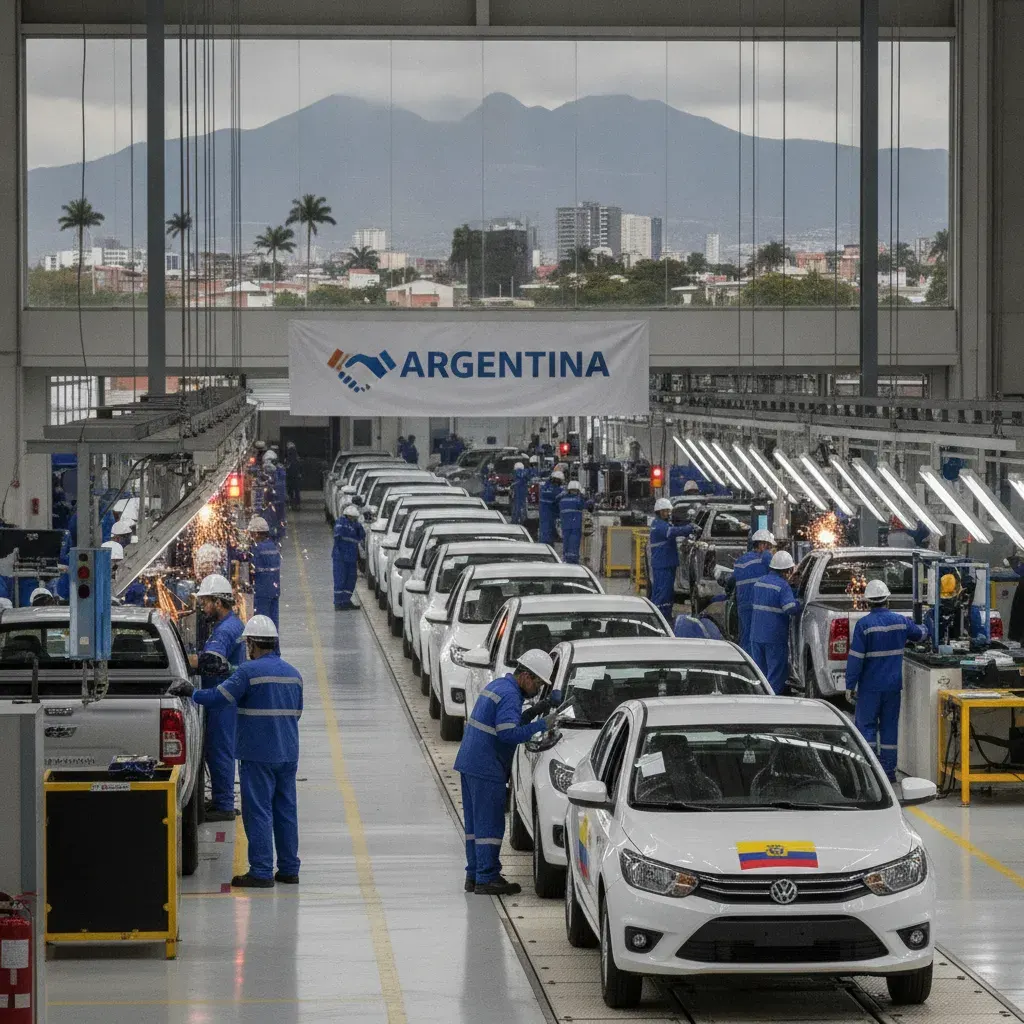
Ecuador’s locally assembled vehicle market had its strongest month of 2026 in July, with 1,649 locally assembled cars sold. That was 38% above July 2025 and the strongest July performance since 2022.
Sales of vehicles made in Ecuador reached 9,571 units in the first seven months of 2026. That total is already above the 8,030 units recorded in 2025 and close to the 9,799 units sold during the same comparison period in 2024. It remains below the 12,035 units recorded in 2023.
The numbers point to a manufacturing sector that is recovering, but the next phase will be shaped by trade policy as much as by local demand.
Ciauto is planning for more output
The Ciauto assembly plant in Ambato says it wants to stabilize production at 1,000 units per month. The company plans to invest USD 70 million during 2026, including USD 20 million in infrastructure.
The Ambato facility assembles 13 models across three brands: Shineray, KYC, and Great Wall Motors. The source describes different local-assembly shares for those brands, but the broader point is more important for the Ecuadorian economy: the plant is operating inside a supply chain that includes assembly, components, logistics, and technical work.
Another local manufacturer, Aymesa, has installed capacity of 36,000 units annually and assembles Kia, Hyundai, Chevrolet, and Suzuki models. The company is also carrying out the processes needed to export the Kia Sonet and Tasman, assembled in Ecuador.
What changed with Argentina
Ecuador and Argentina signed a new automotive agreement during Argentine President Javier Milei’s visit to Ecuadorian President Daniel Noboa on August 6, 2026.
The arrangement sets a reciprocal vehicle tariff of 10% and a preferential quota of 3,000 units from each country for 10 years. In the comparison described in the report, Argentina’s tariff on Ecuadorian vehicles falls from 28% to 10%, while Ecuador’s tariff on Argentine vehicles falls from 15% to 10%.
For Ecuador, the agreement creates two different effects. It opens a clearer export route for vehicles assembled locally, while also increasing competitive pressure from Argentine imports. The concern is particularly strong around pickup trucks because Argentina has a major production line in that category.
The agreement is therefore not simply a story about cheaper cars. It is a trade-policy change that may affect production decisions, model availability, employment, and the balance between imported and locally assembled vehicles.
What This Means for Expats
Foreign residents who plan to buy a vehicle should watch how the agreement affects model availability and pricing rather than assuming that a lower tariff will immediately reach every showroom. People considering work or investment connected to manufacturing, logistics, parts, or vehicle retail have a more direct reason to track the next steps.
The useful indicators are monthly local-assembly sales, whether Ciauto sustains its 1,000-unit target, Aymesa’s export progress, and which Argentine models enter Ecuador under the preferential quota.
Source: Primicias
More in Economy
View all →Ecuador's Remittances Set to Reach Historic High of $8.02 Billion in 2026, Fueling Economic Growth and Housing Initiatives
September 21, 2026
Gapal Interchange Award Delayed Amid Bidder Claims in Cuenca, Road Studies Progress in Azuay
September 21, 2026
Ecuador Boosts Power Supply with Additional Barges Amid Energy Concerns, Targeting Industrial Sector
September 20, 2026
Keep practical Ecuador coverage free to read.
Reader support helps fund source monitoring, translation, editing, publishing, and national coverage for expats across Ecuador.
Need help with your Ecuador visa? EcuaPass handles the paperwork for you. Learn more →
Comments
No comments yet. Be the first to share your thoughts!