Quito’s Camera Network Is Now at the Center of a Government-Municipal Dispute

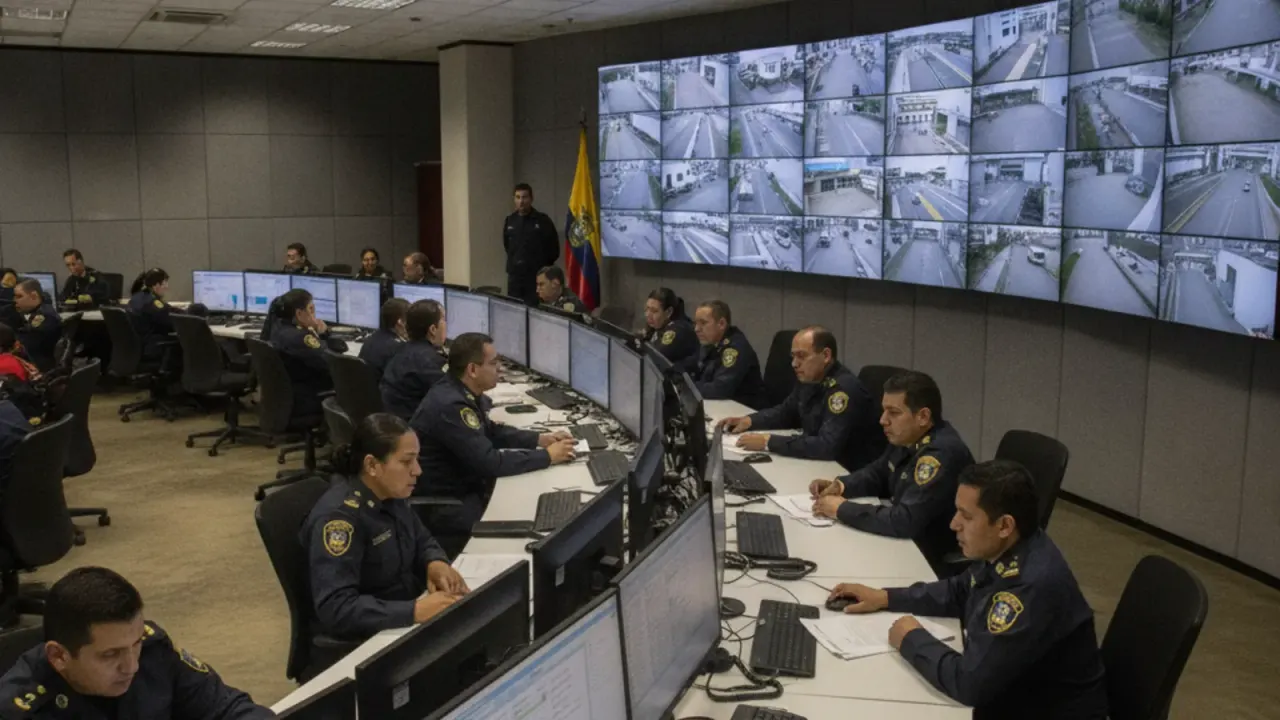
A dispute over who can access and administer Quito’s municipal surveillance network has moved into the national political conversation. Interior Minister John Reimberg said the city’s camera center had connections to “five or six” mirror rooms, while the municipality has said the ECU 911 already had access and total control of the city’s cameras.
The disagreement followed a government announcement of an interinstitutional cooperation agreement with Emseguridad, the Metropolitan Public Company for Security Logistics. Primicias reported that police took control of the municipal camera center on the afternoon of August 10, 2026.
The competing accounts
Reimberg said the camera center was a separate office inside the ECU 911 building and that the national government did not administer the municipal equipment. He also said police discovered the connections after taking control and announced investigations.
The minister’s statement was specific: “Hay cinco o seis salas conectadas a las cámaras de la ciudad de Quito.” The article does not identify each room, its operator, or what type of access it had.
The municipality’s position is different. It said the ECU 911 already had access and total control of 632 municipal cameras acquired between 2016 and 2020. Those cameras are operated from the Sala del COE Metropolitano, in the same ECU 911 building.
The source also reports that the municipality rejected earlier allegations about former intelligence personnel working inside the city government as claims made without proof or evidence. That means the public dispute currently contains allegations and institutional responses, not a completed independent finding.
Why access matters
Municipal cameras are part of the public-safety infrastructure that residents and businesses see but rarely examine. The important operational questions are who is authorized to view feeds, who stores or shares footage, what procedures apply to investigations, and how responsibility is divided between the municipality, ECU 911, police, and Emseguridad.
Those questions matter to foreign residents because surveillance, emergency response, and public-space security do not stop at a person’s nationality. They affect neighborhoods, businesses, roads, and the handling of incidents in the capital.
What This Means for Expats
There is no new instruction for residents to follow in the report. The practical move is to distinguish the minister’s allegations from confirmed system changes and to watch for the announced investigation or a formal operating agreement that explains access and accountability.
Businesses that rely on security footage should keep their own incident records and ask the relevant authority for the correct reporting channel. Residents should also avoid treating a political statement as proof that every municipal camera is being used improperly. The current story is about contested control of a public system; the next useful document will be the one that clarifies how that system is actually governed.
Source: Primicias
More in Politics
View all →Cuenca's Suspended Mayor Cristian Zamora Faces Illicit Enrichment Charges, Denies Allegations From Mexico
September 22, 2026
Xavier Jordán Detained in U.S., Faces Deportation to Ecuador Amidst Multiple High-Profile Cases
September 18, 2026
Ecuador Dismantles Anti-Corruption Unit, Raising Concerns for Judicial Integrity and Security
September 18, 2026
Keep practical Ecuador coverage free to read.
Reader support helps fund source monitoring, translation, editing, publishing, and national coverage for expats across Ecuador.
Comments
No comments yet. Be the first to share your thoughts!